
Total Asset Visibility
Service Management
Better decisions on costs, licences and lifecycle start with one connected view of your IT assets.

What are you paying for, who is using it, and what does it support? Connecting discovery with IT asset management and service management brings the information together, giving teams a clearer basis for decisions—from the next software renewal to retiring ageing infrastructure.

Take a software renewal. Procurement holds the contract, finance holds the cost, and IT holds the installations. Each view is accurate on its own. Brought together, they answer the question that matters: how much does the organisation need for the next contract period?
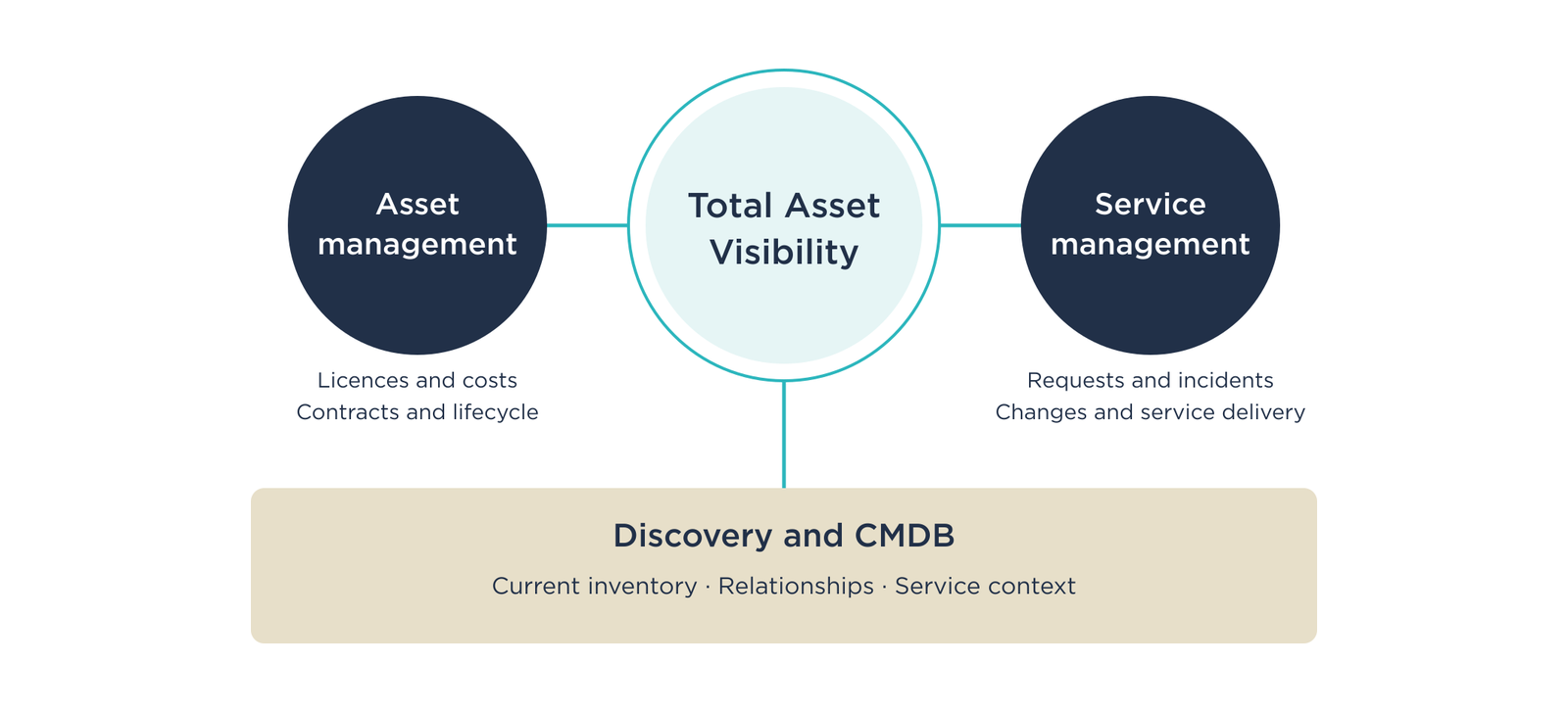
Total Asset Visibility is a connected view of the technical, financial and contractual information about every IT asset throughout its lifecycle. It links what exists with who is responsible for it, what it costs, which agreements apply and how it supports the business
Discovery identifies hardware, software and infrastructure. Asset management adds ownership, costs, entitlements and lifecycle information. Service management connects those records to requests, incidents and changes. Together, they give different teams one consistent picture to work from, and regular reconciliation keeps that picture current and ownership clear.
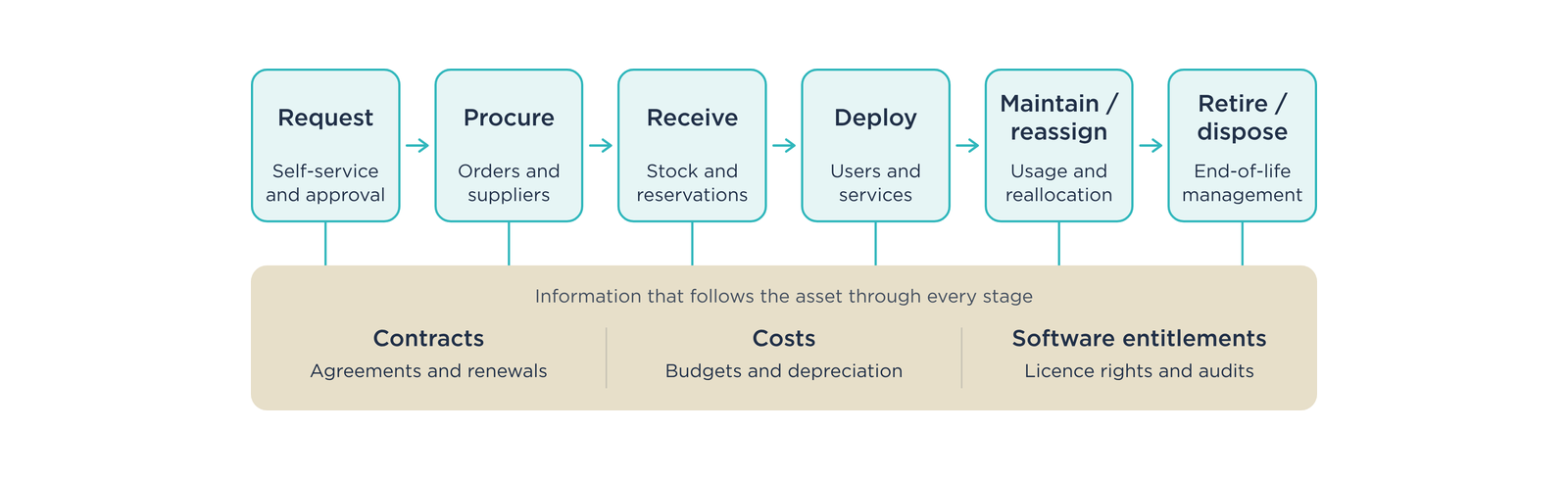
An asset starts costing money before it appears on the network. Its lifecycle runs from request and procurement through receipt, deployment and maintenance to retirement and disposal. Contracts, costs and software entitlements stay connected to the asset at every stage.
When an employee leaves, their laptop can go to a colleague and software subscriptions can be reclaimed where the agreement allows. Before a server is retired, teams confirm its dependencies and review the related support and licence commitments. A technical change and a financial decision often belong to the same process.
Software asset management (SAM) brings together installations, usage and licence rights. Combined, they help teams assess their licence position and understand actual usage. Alongside future business requirements, this provides a stronger basis for deciding what to renew, reassign or retire.
Teams can see where more licences are needed and where spend can be reduced, and IT can reallocate licences or review unused subscriptions. Which licences are needed? What evidence supports the calculation? Which contract terms apply? Answers that trace back to current records give procurement a strong starting point for every renewal discussion.
OpenText Universal Discovery and CMDB discovers configuration items and maps their relationships across hybrid IT environments. OpenText Asset Management adds the financial and contractual context: lifecycles from procurement request to disposal, vendor and support contracts, depreciation and budgets, and software entitlements compared with calculated licence requirements.
Connected to OpenText Service Management, this information supports daily service delivery. A replacement request can draw on available stock, and a change can be assessed against the services it affects. OpenText Universal Discovery and CMDB also integrates with ITSM platforms such as ServiceNow, BMC Helix and Jira Service Management, so organisations can build on the tools they already use.
AI recommendations are as good as the information behind them. An assistant suggesting a purchase benefits from knowing what is already in stock, and a recommendation to retire infrastructure needs context about the services it supports.
Reliable asset records give people, systems and AI agents a solid foundation to work together. The organisation decides which information is authoritative, who maintains it and which decisions require human approval, and connected data makes those responsibilities easier to put into practice.
IT asset management (ITAM) is the practice of managing hardware and software assets throughout their lifecycle, from request to retirement. It combines inventory, ownership, financial and contractual information so organisations can make well-founded decisions about what to buy, use, reassign and retire.
Software asset management (SAM) is the part of ITAM that focuses on software. It covers licence entitlements, deployments and usage, so organisations can manage software costs and stay compliant with their licence agreements.
OpenText Asset Management calculates licence requirements using relevant inventory and configuration data and compares them with recorded entitlements. This helps identify potential shortfalls and opportunities to optimise allocation and spending, subject to the applicable licence terms.
Start with one defined asset group or one decision, such as an upcoming software renewal. Establish ownership, reconcile inventory with contracts and costs, and measure how the improved information helps the team act.
As a certified OpenText ITOM specialist partner, Swedwise provides consultancy and licensing, with experience implementing and integrating asset management, discovery, CMDB and service management solutions, including integration with HR and finance systems. We help connect the technology with the processes and information your organisation relies on. The result is digital clarity, and more time for the work that matters.
Service Management
Better decisions on costs, licences and lifecycle start with one connected view of your IT assets.

Build a flexible integration capability around your needs. Meet Swedwise at Nordic APIs Summit.

System Integration
Combine platforms and specialist capabilities to create secure, flexible information flows.